Why You Can't Hold Your Handstand (And What to Do About It)
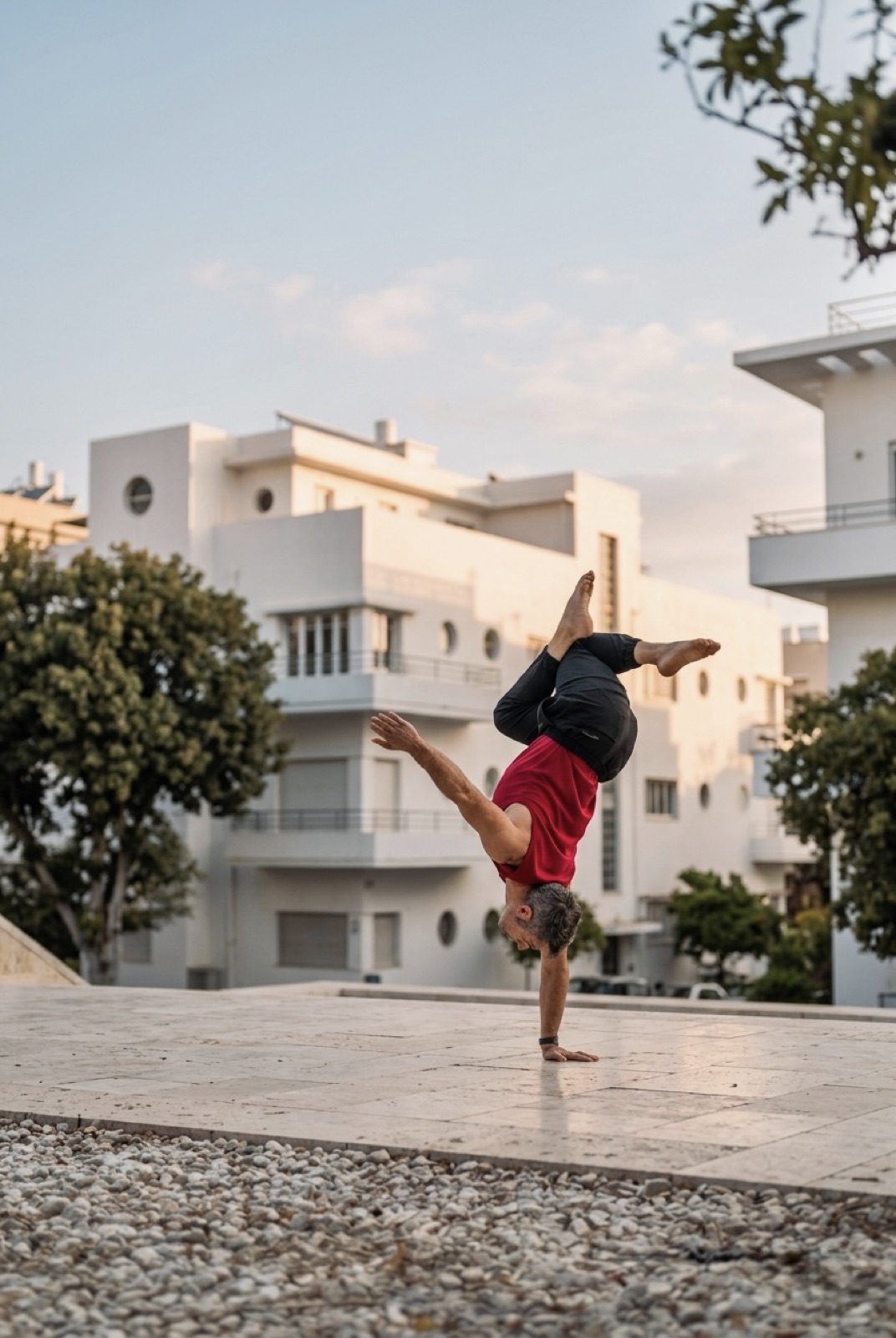
You can kick up. You can hold the wall. But the moment you leave it, you fall. Here's what's actually going on - and how to fix it.
You've been training for months. You can hold a solid wall handstand. You have the strength. You can kick up cleanly. But the moment you try to balance away from the wall, you fall within a second - sometimes immediately.
This is one of the most common plateaus in handstand training. And almost everyone who hits it assumes the same thing: they're just not strong enough yet, or their technique isn't clean enough, or they need to train more.
Usually, none of those things are the real problem.
The wall handstand is a different skill
Here's something that surprises most people: a wall handstand and a freestanding handstand are not the same skill practiced at different difficulty levels. They are genuinely different things.
Against the wall, you have a fixed reference point. You know where you are. You can relax into it, push hard, and hold for minutes. The wall removes the essential challenge of balance - which is that you are always falling, always correcting, always in motion.
A freestanding handstand is alive. You are constantly making tiny adjustments - primarily through your palms and fingers. That's where the real balance conversation happens. Shoulder corrections are much bigger movements, less precise. The hands are where the fine-tuning lives. The moment those adjustments stop - the moment you lock up and hold your breath and try to freeze - you fall.
If you've spent most of your training time on the wall, you have built strength but not the balance sense that freestanding requires. These are genuinely different adaptations.
The most common technical reasons you fall immediately
You're kicking up to the wrong position
Most beginners kick up with too much force and overshoot, landing in a banana shape with their hips behind their shoulders. From there, balance is almost impossible - the geometry is all wrong. The entry matters as much as what happens once you're up.
Your shoulders are not fully open
A handstand requires your shoulders to be fully elevated - ears between your arms, arms pressing actively into the floor. If your shoulder mobility or strength is limited, you will compensate by bending somewhere else (usually the lower back), and that compensation shifts your centre of gravity off the ideal line.
You're gripping too hard
Some tension is necessary - you are holding your entire body upside down, after all. But too much tension is what kills balance. When you grip the floor with a death clench, you lose the sensitivity in your palms and fingers that you actually need to feel and respond to what's happening. The grip should be active, not desperate. Attentive, not clenched.
You hold your breath
Breath and balance are deeply connected. Holding your breath creates full-body tension and freezes the small adjustments your body needs to make. Breathe - slowly, deliberately - when you're upside down.
Where your eyes are looking
You want to stare at the floor in a way that also lets you see your hands - roughly around your wrist level is natural. What you don't want is to strain your eyes trying to look too far "up" (which in a handstand means towards the ceiling behind you). When the eyes work too hard, the neck tenses, and that tension travels. Keep the gaze soft and steady.
What actually trains freestanding balance
Before anything else, you need to understand what balance actually is in a handstand. There are two directions you're always correcting between: over - falling forward, towards the fingers - and under - falling back, towards the heel of the hand and wrist. All balance work is learning to feel which way you're going and respond to it.
The wall is your best teacher here - but how you use it matters enormously.
CTW (Chest to Wall): facing the wall with your chest, you practice shifting weight over - pressing into your fingers, moving away from the wall, finding that forward edge of balance. This is where most people need to spend time, because the instinct is always to stay too safe, too far back.
BTW (Back to Wall): back to the wall, you practice pushing away - driving high through the shoulders, rounding the upper back and pelvis slightly to find the line. The critical thing here: don't push the wall with your feet. It's one of the most common mistakes and it defeats the whole purpose. The feet should barely touch - or ideally not touch at all. The wall is there as a safety net, not something to lean into.
This is the real work. Not just kicking up and hoping. Understanding the two directions, feeling which way you're drifting, and training your response to each one.
The mindset shift that changes everything
Most people approach a freestanding handstand as something they need to achieve and hold. The moment it wobbles, they tense up, fight it, and fall.
The people who progress fastest are those who learn to stay curious when it wobbles. To feel what's happening - where the weight is shifting, what the fingers are sensing - and respond to it rather than resist it.
You are not trying to freeze. You are learning to dance with instability.
The handstand doesn't reward force. It rewards attention.
A note on timelines
If you have been stuck at this plateau for more than a few months, it's almost certainly a training approach issue, not a talent or potential issue. A fresh set of eyes - a good teacher, a structured programme, even filming yourself and reviewing what's actually happening - can shift things dramatically and quickly.
The plateau is not a dead end. It's a signal that something in the approach needs to change.
Yuval Oz
Hand balancer and handstand coach. Teaching people to get upside down - and stay there - since 2008.
Stay in the loop
Get new posts and updates
No noise. Just new articles, upcoming workshops, and things worth knowing.